
Have you ever watched a young child stack blocks over and over again with complete focus? To an adult, it may seem like simple play. But in a Montessori classroom, this kind of activity is carefully designed to support deep learning.
One of the most iconic Montessori materials is the Pink Tower. At first glance, it appears to be nothing more than ten beautiful pink wooden cubes. Yet behind its simple appearance lies a thoughtfully designed educational tool that nurtures a child’s cognitive, physical, and emotional development.
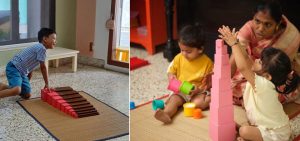
At Brixton House Montessori, the Pink Tower is introduced as part of our Sensorial curriculum, where children learn by exploring through their senses. This material helps children build concentration, refine their movements, develop visual perception, and lay the groundwork for future mathematical concepts—all while experiencing the joy of discovery.
In this article, we’ll explore what the Pink Tower is, why it is such an important Montessori material, and how it supports your child’s development.
What Is the Montessori Pink Tower?
The Pink Tower is a classic Montessori Sensorial material consisting of ten solid wooden cubes, all painted the same shade of pink.
The cubes vary in size from:
- 1 cm³ (the smallest cube)
- 10 cm³ (the largest cube)
Each cube differs from the next by exactly 1 centimetre in every dimension.
Children are invited to carry each cube individually, compare their sizes, and carefully stack them from largest to smallest to create a perfectly balanced tower.
Although the activity seems straightforward, it involves careful observation, precise movement, and thoughtful problem-solving.
Why Is the Pink Tower Pink?
Many parents wonder why every cube is exactly the same colour.
This is intentional.
Montessori materials are designed to isolate one concept at a time. Since the learning objective is to understand size and dimension, colour should not become a distraction.
Using a single colour helps children focus entirely on differences in volume, height, width, and depth.
This simplicity allows children to make clear visual comparisons without unnecessary sensory overload.
The Educational Purpose of the Pink Tower
The Pink Tower is much more than a stacking activity.
It develops several essential skills simultaneously.
1. Visual Discrimination
Children learn to notice very small differences in size.
As they compare cubes, they begin recognizing:
- Bigger and smaller
- Largest and smallest
- Thick and thin
- Gradual changes in dimension
These observation skills are fundamental for reading, mathematics, science, and everyday problem-solving.
2. Concentration
Building the tower requires careful attention.
If one cube is placed incorrectly, the tower may become unstable.
Children naturally slow down, observe carefully, and work methodically.
Over time, this repeated experience strengthens their ability to focus for longer periods—an essential life skill that benefits learning across all subjects.
3. Fine Motor Skills
Each cube must be lifted, carried, positioned, and balanced with precision.
These movements strengthen:
- Hand muscles
- Finger control
- Wrist stability
- Hand-eye coordination
These skills later support handwriting, drawing, self-care tasks, and practical life activities.
4. Independence
Montessori encourages children to learn through self-discovery rather than constant adult correction.
The Pink Tower contains a built-in control of error.
If cubes are stacked incorrectly, children usually notice the imbalance themselves.
Instead of relying on an adult to point out mistakes, they naturally adjust and improve their work.
This process builds confidence and resilience.
5. Preparation for Mathematics
Although the Pink Tower is not a maths material, it prepares children for mathematical thinking.
As children work with the cubes, they unconsciously explore concepts such as:
- Sequencing
- Gradation
- Comparison
- Dimension
- Volume
- Measurement
- Spatial awareness
These experiences create a concrete foundation before abstract mathematical symbols are introduced.
How the Pink Tower Supports Whole-Child Development
At Brixton House Montessori, we believe learning should nurture every aspect of a child’s growth.
The Pink Tower contributes to:
Cognitive Development
Children classify, compare, analyse, and solve problems independently.
Physical Development
Carrying cubes around the classroom develops balance, coordination, and body awareness.
Emotional Development
Completing the tower gives children a genuine sense of accomplishment.
Rather than receiving rewards, they experience the intrinsic satisfaction of mastering a challenging task.
Social Development
Children often observe one another, share ideas respectfully, and celebrate each other’s work while maintaining individual ownership of their learning.
The Montessori Presentation
One of the defining features of Montessori education is that every material is introduced carefully.
When presenting the Pink Tower, the guide:
- Invites the child to the shelf.
- Carries each cube slowly to a work mat.
- Demonstrates how to compare sizes.
- Builds the tower from largest to smallest using precise movements.
- Steps back and allows the child to explore independently.
This respectful approach encourages observation rather than instruction.
Children are trusted to learn through experience.
Extensions and Variations
Once children master the basic tower, they often explore new challenges.
Examples include:
Horizontal Arrangement
Laying cubes from largest to smallest in a straight line.
Grading Exercises
Comparing individual cubes and identifying size relationships.
Mystery Bag Activity
Feeling cubes without looking and identifying them through touch.
Combining Materials
The Pink Tower is sometimes paired with the Brown Stair to deepen understanding of dimensions and spatial relationships.
These extensions keep learning engaging while reinforcing foundational concepts.
What Parents Can Learn from the Pink Tower
The Pink Tower reminds us that meaningful learning doesn’t always require complicated toys or digital devices.
Children benefit most when they have opportunities to:
- Work independently.
- Repeat activities.
- Solve problems themselves.
- Develop patience.
- Experience success through effort.
At home, parents can encourage similar skills by allowing children time to build with blocks, sort objects by size, stack household containers, or help organize items from smallest to largest.
The goal isn’t to recreate Montessori materials but to nurture the same spirit of exploration and independence.
Why the Pink Tower Remains Relevant Today
In today’s fast-paced world, children are often surrounded by flashing lights, noisy toys, and constant stimulation.
The Pink Tower offers something refreshingly different.
It teaches children that learning can be quiet.
It encourages patience instead of speed.
It rewards concentration instead of distraction.
Most importantly, it helps children discover that they are capable learners who can solve problems through careful observation and persistence.
These are qualities that extend far beyond the classroom.
The Brixton House Montessori Approach
At Brixton House Montessori, every Montessori material is introduced with purpose and respect for the child’s developmental stage. The Pink Tower is not simply an educational resource it is an invitation for children to think independently, move carefully, and build confidence through meaningful hands-on experiences.
By allowing children to explore at their own pace, we help cultivate curiosity, resilience, and a lifelong love of learning.
Key Takeaways
- The Pink Tower is one of the foundational Montessori Sensorial materials.
- It develops visual discrimination, concentration, coordination, and fine motor skills.
- Children build early mathematical understanding through hands-on exploration of size and dimension.
- The material encourages independence by allowing children to identify and correct their own mistakes.
- Simple, purposeful activities often provide deeper learning than highly stimulating toys.
- At Brixton House Montessori, the Pink Tower is presented in a way that respects each child’s natural pace of learning.
Frequently Asked Questions
At what age is the Pink Tower introduced?
Most children are introduced to the Pink Tower between 2½ and 4 years, depending on their individual readiness and interest.
Is the Pink Tower a mathematics material?
Not directly. It is part of the Montessori Sensorial curriculum but provides a concrete foundation for later mathematical concepts such as sequencing, measurement, and geometry.
Why are all the cubes the same colour?
The uniform pink colour helps children focus exclusively on differences in size and dimension without being distracted by colour.
Can parents use similar activities at home?
Yes. Stacking blocks, sorting household items by size, nesting containers, and building with wooden cubes all encourage similar developmental skills while supporting independence and problem-solving.
Why do children repeat the activity so often?
Repetition helps children refine their movements, strengthen concentration, and gain mastery. In Montessori education, repetition is a natural and valuable part of learning.
In our latest article, we explore how this beautifully simple material reflects the Montessori philosophy of learning through purposeful, hands-on experiences and why it continues to be a cornerstone of early childhood education.
Read the full article to discover how meaningful learning begins with carefully designed experiences.
Suggested Instagram Caption
The Pink Tower is much more than a stack of cubes!
Every carefully placed cube helps children develop:
- Concentration
- Fine motor skills
- Independence
- Spatial awareness
- Early mathematical thinking
At Brixton House Montessori, children learn through hands-on exploration that builds confidence one cube at a time.